
How to Calculate Gutter and Drainage Capacity
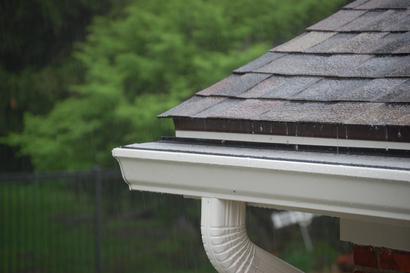
In Florida, rainfall patterns are characterized by nearly eight inches of precipitation per month during the summer months of June through August, tapering to six inches in September, and settling at approximately two inches per month for the remainder of the year. Given these precipitation trends, it’s crucial to select the appropriate gutters, downspouts, and drainage systems to safeguard your home’s foundation.
The accumulation of excess water around your home can lead to significant foundation issues, including cracks and potential flooding in crawl spaces. It’s important to stay on top of gutter and drainage care before the next storm hits. In this article, we’ll explain how to calculate your home’s drainage capacity.
Rainfall Drainage Challenges
There are several elements to consider when assessing rainfall water management around your home. It starts at the roof, routes through the gutters and downspouts, then meets up with still more water already on the ground. Here are the critical items:
- Roof total surface area
- Roof pitch, including hips and valleys
- Gutter size, shape, and slope
- Downspout size, shape, position, and number
- Downspout extensions to direct water flow away from the foundation
- Grading around the foundation to move the water away
- Crawl space waterproofing
Rainfall on a Single-Story 1,600-Square-Foot-Home
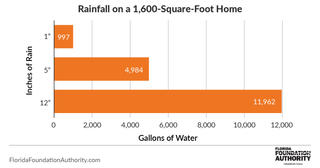
In the example shown below, a single-story 1,600-square-foot home accumulates nearly 1,000 gallons of water from just one inch of rain. Add a few more inches and the gallons advance rapidly, hitting nearly 5,000 gallons at five inches.
Rainfall on a 1,600-square-foot home
- 1″ of rain: 997 gallons of water
- 5″ of rain: 4,984 gallons of water
- 12″ of rain: 11,962 gallons of water
It’s easy to see how gutters could be overwhelmed in a downpour. This can cause overflow with hundreds of gallons of water rushing off the roof, over the gutters, and falling directly on your foundation.
Roof Structure and Water Volume
Roof structure further impacts rain collection and the overall flow of water from the roof. For example, the steeper the roof’s pitch, the more roof surface area and the quicker the rain moves to the gutters. Also, wind can blow more rain onto a steeply pitched roof.
Roof pitch factor is measured by the roof’s rise over a 12-inch run. If the rise is five inches, that’s a 5-in-12 pitch or a pitch factor of 1.05.
Another thing to take into account is the roof’s peaks and valleys. Valleys can collect water from two roof surfaces and bring all that to a small section of your gutters.
Gutter and Downspout Capacity Calculations
Here’s the list of the items needed to calculate gutter and downspout capacity correctly:
- Home square footage or footprint
- Roof pitch, along with any peaks and valleys
- Gutter shape, K-style or half-round
- Gutter dimension
- Downspout size, shape, and slope
- Expected rainfall intensity in your area
Example Calculation for Orlando
The expected rainfall intensity can be found in the NOAA Weather Service’s detailed precipitation frequency estimates. We selected Orlando WSO AP as the location. Moving to the table below the map, we find that the five-minute expected rainfall burst likely over 10 years is 0.723 inches. We must convert that to inches per hour: 0.723 x 12 equals 8.676 inches.
With an 800-square-foot home with a roof pitch of 4-in-12 and a pitch factor of 1.05, the total roof watershed is 800 x 1.05, or 840 square feet. Then multiplied by the expected rainfall intensity of 8.676 inches, the drainage capacity results in 7,287 square feet.
A K-style five-inch gutter has a capacity of 5,520 square feet. This is far less than our required drainage capacity. Instead, the six-inch K-style gutter with a capacity of 7,960 square feet should be used.
Downspouts must also be sized to handle this level of rainfall. Rectangular 2 x 3-inch downspouts have a capacity of 600 square feet, while 3 x 4-inch downspouts can handle 1,200 square feet. Choosing the 3 x 4-inch rectangular downspouts, we’d need at least seven to handle the expected water flow.
Above Ground and Underground Water Issues
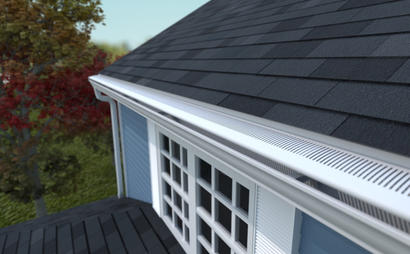
With correctly sized gutters and downspouts, the rainfall can move quickly from roof to gutter to downspout to the ground. Once on the ground, it needs to be routed away from the home’s foundation. That can be accomplished with proper grading of the soil and downspout extensions, all correctly positioned to move that water out and away.
However, all that rain falling on your roof has also been falling on your lawn and saturating the soil. This causes underground water to pool, which flows toward the foundation rather than away.
It flows in this direction due to the clay bowl effect, which is the result of excavating the soil before foundation construction and then backfilling. The backfilled soil has a different drainage factor than the rest of your lawn. It’s loose rather than compact. Unfortunately, this allows the water to more easily flow toward the foundation.
The best way to deal with this is crawl space waterproofing with interior drains and a sump pump, accompanied by encapsulation with a vapor barrier.
Water Damage Repair Costs
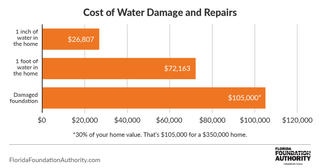
FEMA has developed cost estimates of the impact of several different levels of home flooding. Those are highlighted in the chart here.
Cost of Water Damage and Repairs
(2,500-square-foot single-story home)
- 1 inch of water in the home: $26,807
- 1 foot of water in the home: $72,163
- Damaged foundation: Lose up to 30% of your home value. That’s $105,000 for a $350,000 home.
Protect Your Home with Alpha Foundations

The risk of water damage to your home’s foundation is real and significant. Excess moisture can lead to cracks, flooding in crawl spaces, and heaving in slab foundations due to soil expansion. These issues not only threaten the structural integrity of your home but can also lead to costly repairs and a decrease in property value.
To mitigate these risks, you must ensure that your gutters, downspouts, and drainage systems are correctly sized and installed. Don’t wait for the next heavy rainfall to find out if your home is protected. Call Alpha Foundations today to schedule a no-cost, professional inspection today to safeguard your home’s foundation against water damage.
Related Resources



Groundworks
Publish Date:
Last Modified Date:
Our Locations
1755 Benchmark Ave.
Fort Myers, FL 33905
55 North Industrial Loop
Orange Park, FL 32073
3200 W Copans Rd.
Pompano Beach, FL 33069
3723 Hogshead Rd
Apopka, FL 32703
66 Industrial Park Dr.
Monticello, FL 32344
1615 118th Ave. N
St. Petersburg, FL 33716
515 N Flagler Dr.
Ste. P-300
West Palm Beach, FL 33401